
Pogo Pin in Smart Glasses: Creating the "Invisible Artery" for AI Wearables
I. Pogo Pin: A Miniature Revolution in Precision Connection Technology
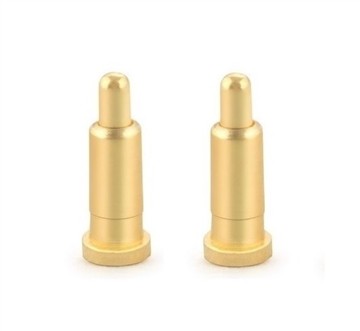
Pogo Pin, commonly known as a spring‑loaded pin, is a spring‑loaded probe connector formed by precision riveting of three components: a plunger (needle shaft), a spring, and a barrel. The name derives from the classic toy "Pogo Stick" because the pin's tip moves axially like a pogo stick when compressed. Inside the Pogo Pin, a tiny coil spring ensures that when the pin contacts an external pad, the tip compresses inward, providing a consistent and stable contact force. This guarantees low‑impedance, reliable transmission of current or signals.

The core advantage of Pogo Pin lies in its ingenious spring‑loaded design: a spring inside the barrel, and electrical continuity achieved through precise friction and spring force between the plunger and barrel. The plunger moves axially under spring force; any physical displacement caused by vibration, shock, or thermal expansion/contraction is absorbed and compensated by the spring's elasticity, maintaining a stable electrical connection. To enhance corrosion resistance and signal quality, Pogo Pins are typically gold‑ or nickel‑plated.
Thanks to their tiny size, ultra‑low impedance, and long mating life, Pogo Pins are widely used in smartphones, laptops, tablets, smartwatches, Bluetooth headsets, TWS charging cases, VR headsets, wearable medical devices, automotive electronics, and aerospace. In modern wearable design, Pogo Pins have evolved from a background test/programming connector to a front‑line component reshaping device architecture and user experience.

II. Core Application Scenarios of Pogo Pins in Smart Glasses
With the explosive growth of large AI models and continuous AR/VR advances, smart glasses are moving from conceptual exploration to mass adoption. Global tech giants such as Meta, Google, Apple, and Samsung are heavily investing. Industry consensus points to 2026–2027 as the tipping point for explosive growth. Smart glasses must pack batteries, main chips, optical display modules, antennas, sensors, microphones, and speakers into an extremely compact volume-every cubic millimeter is precious. At the same time, users demand all‑day comfort, convenient charging, sweat/water resistance, and seamless aesthetics.

Pogo Pins meet these stringent requirements and serve three primary application scenarios in smart glasses.
(1) Magnetic charging and data transfer on the temple arm
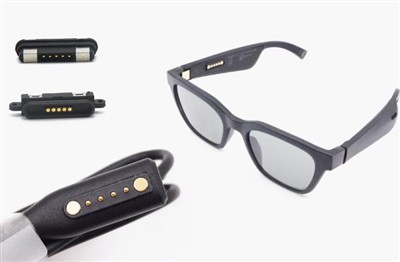
This is the most mature and common application. The Pogo Pin female connector is embedded on the inner side of the temple arm or near the hinge. The mating magnetic charging cable or dock contains male Pogo Pins and magnets. When the user places the glasses near the charger, magnetic force automatically guides them into the correct position, enabling blind‑attachment charging.

With multiple pins, the Pogo interface can also support parallel functions-different pins can handle power, video signals, control signals, or audio, enabling both charging and high‑speed data transfer over a single magnetic cable. For example, the Thunderbird Innovation AI shooting glasses V3 use an 18‑pin magnetic data cable to achieve USB 3.0 fast data export for high‑resolution video and photos.

(2) Smart glasses case (charging case) solution
Inspired by TWS earphone cases, some smart glasses come with a dedicated charging case. Inside the case, a Pogo Pin charging dock is integrated. When the glasses are placed into the case, metal contacts on the temple or frame automatically align with the case's Pogo Pins, starting immediate charging. A Hall sensor can initiate inductive charging as soon as the lid is opened, delivering a seamless "store‑and‑charge" experience.

(3) Frame‑embedded and modular expansion
Pogo Pins can be embedded directly into the eyeglass frame, integrating structural and circuit design. The connector merges with the frame skeleton to achieve electrical connections within millimeter space. This not only saves layout space but also opens possibilities for modular expansion-users can magnetically attach camera modules, display modules, or other peripherals via Pogo Pin interfaces, making smart glasses more flexible and upgradeable.

III. Why Choose Pogo Pin? Five Core Advantages
Compared with Type‑C wired charging or wireless charging, the Pogo Pin magnetic connection has rapidly become the mainstream solution in smart glasses due to five key advantages.

(1) Extreme space efficiency
Smart glasses must be slim-the thickest part of a temple is often less than 8 mm. A standard Type‑C receptacle is over 3 mm tall and requires additional clearance for insertion slope and housing wall, easily consuming >30% of internal volume. In contrast, a Pogo Pin female connector can be as low as 1 mm, hidden discreetly on the temple's inner side or hinge, leaving room for batteries, antennas, main chips, and heat spreaders. In the battlefield of smart glasses where every cubic millimeter counts, this is critical.

(2) Ultra‑long mating life and reliability
Smart glasses are high‑frequency daily wearables, requiring far higher mating durability than ordinary consumer electronics. Type‑C connectors with mechanical latches and spring contacts typically have a laboratory life of ~10,000 cycles; in real use, loosening can occur after 3,000‑5,000 cycles. Pogo Pins, relying on spring‑loaded pins and magnets with no friction wear from latches, commonly achieve 50,000 to 100,000 cycles-some high‑performance versions exceed 500,000 cycles, far exceeding general consumer standards. Even after 20,000 real‑world mating cycles, contact resistance change can be kept within 10 mΩ, with almost no electrical degradation.

(3) Excellent sweat and water resistance
Smart glasses are often used during running, cycling, or outdoor activities, facing sweat and rain. Type‑C ports require an open cutout, making complete sealing impossible; sweat ingress can cause oxidation, corrosion, or even short circuits. Pogo Pin magnetic female contacts can be designed as a flush stainless steel pad, then sealed with silicone gaskets or nano‑molding to easily achieve IP67 or even IP68 protection, effectively resisting sweat, rain, and dust.

(4) Blind mating convenience and safety
Users taking off their glasses to charge often do so with one hand, not looking at the port-charging must be truly effortless. Magnetic Pogo Pins use strong neodymium magnets for precise alignment, with ramped guides, enabling blind‑attach automatic connection in milliseconds (0.2 seconds) without flipping or precise aiming. Moreover, if the cable is accidentally pulled, the magnetic connection cleanly disconnects, preventing the glasses from being dragged off the desk or dock-protecting both the device and the user.

(5) Clean, integrated aesthetics
As consumer electronics aesthetics converge, a pure, seamless design becomes increasingly important. A magnetic Pogo interface can be completely hidden within the temple or frame structure, leaving no visible cutouts or protrusions. The smart glasses thus resemble ordinary eyewear, suiting daily wear and social contexts.

IV. Industry Trends and Future Outlook
With the deep integration of AI and AR, smart glasses are rapidly moving from experimental gadgets to mass‑market products. According to industry analysis, AR+AI glasses-the future of smart glasses-are expected to enter sustained growth from 2025 onward, with sales possibly exceeding 2.7 million units by 2027. At CES 2026, AI smart glasses were showcased widely, highlighting trends such as lightweight design, standalone terminal capability breakthroughs, and multi‑chip platform diversity. Major tech companies are investing heavily in next‑generation smart glasses, driving even greater demand for stable power and high‑speed data transmission in compact spaces.

As display technology and AI compute power advance, the power consumption of smart glasses will rise, requiring higher charging currents and faster data rates. Pogo Pin technology continues to evolve-through coaxial shielding and electromagnetic simulation, next‑generation Pogo Pins can support USB 3.1 Gen2 or even Thunderbolt 3 rates (up to 10 Gbps) with low crosstalk and minimal insertion loss. For charging, gold‑plated Pogo Pins can reliably carry over 5A, meeting the fast‑charging needs of smart glasses.

It is foreseeable that as smart glasses evolve from "new species" to "daily companions," Pogo Pin connectors-as the invisible arteries hidden within millimeter spaces-will continue to play a key role in stable connection and superior user experience, deeply integrated with magnetic charging technology. For smart glasses developers, choosing Pogo Pins means choosing not just a connector, but a system‑level solution that balances engineering reliability and user convenience, proven in the market.
