
Basic Introduction to POGO PIN Connectors
POGO PIN connectors (spring-loaded connectors) are precision connection components that use an internal spring mechanism to achieve elastic contact. Their name comes from their appearance and working principle, which resembles a child's toy "pogo stick." The connector contains a precision spring that compresses under pressure and provides continuous contact force, thereby enabling stable and reliable electrical connections.
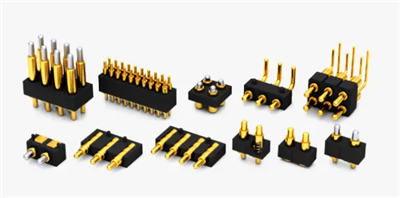
I. Core Structure & Working Principle
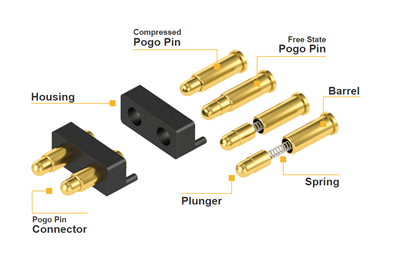
The basic structure of a POGO PIN consists of three main parts:
| Component | Material | Function |
|---|---|---|
| Barrel | Brass, copper alloy, or stainless steel | Outer housing, provides guidance and retention |
| Plunger | Brass, beryllium copper, or stainless steel | Contact end, often uses a tapered or ball shape to reduce insertion/extraction force |
| Spring | Stainless steel, music wire, or beryllium copper | Provides stable contact force |
Working Principle: When the plunger contacts the mating pad, the internal spring compresses and generates a return force, keeping the plunger in constant pressure against the contact surface. This creates a low‑resistance, highly reliable electrical path. The spring‑loaded mechanism accommodates thermal expansion/contraction and vibrations/shocks in dynamic environments.

II. Key Advantages
POGO PIN connectors are widely used in modern electronic products due to these core benefits:
Long service life: 10,000 to over 100,000 mating cycles; high‑end products can reach 1 million cycles.
Small size & space saving: Diameter can be as low as 0.4 mm, pitch down to 0.8 mm – ideal for miniature electronics.
Constant contact force: The spring mechanism self‑aligns and compensates for tolerances, maintaining stable connection under vibration, misalignment, or temperature changes.
Self‑cleaning action: Friction between the plunger and contact pad during mating removes surface oxides, improving contact reliability.
Flexible design & relatively low cost: No need for custom molding; easy to customize dimensions, shapes, and performance specs.
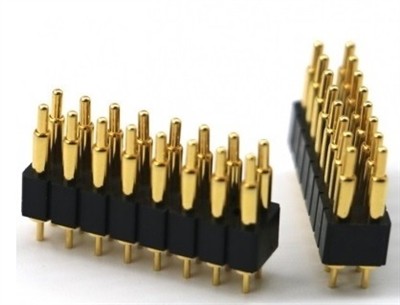
III. Main Disadvantages
POGO PINs also have some limitations:
High precision requirement: Manufacturing accuracy is critical; small deviations can lead to increased defect rates.
Sensitivity to contaminants: The contact point does not move during compression; dust or foreign particles on the contact surface can cause connection failures.
Heat generation at high current: Under sustained high current (e.g., >5 A), noticeable temperature rise may occur.
IV. Key Electrical & Mechanical Parameters
Typical parameters for standard POGO PINs (refer to product datasheets for exact values):
| Parameter | Typical Range |
|---|---|
| Rated Current | 1 A ~ 5 A per pin; high‑current types up to 5 A ~ 60 A |
| Rated Voltage | Usually AC/DC 12 V |
| Contact Resistance | ≤30 mΩ ~ 100 mΩ |
| Insulation Resistance | ≥100 MΩ (500 VDC) |
| Dielectric Withstanding Voltage | AC 500 V (1 minute, no breakdown) |
| Operating Temperature | -40 ℃ ~ +85 ℃; military grade -40 ℃ ~ +125 ℃ |
| Mating Life (cycles) | 5,000 ~ 100,000+ cycles |
| Protection Rating | IP67 / IP68 (with sealing structure) |
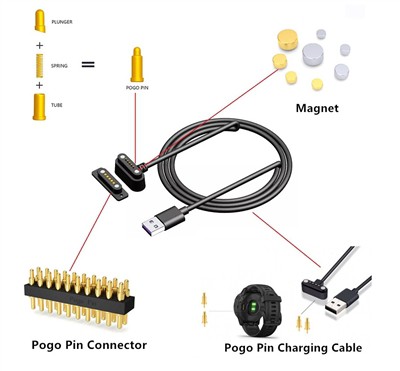
V. Main Types
POGO PINs can be classified by shape and internal design.
1. By shape / mounting style:
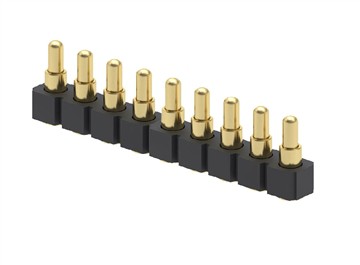
Flat‑bottom / PCB‑mount / Right‑angle bend
Double‑ended / Threaded / Wire‑soldering / Side‑hole
2. By internal structure:
Reverse‑drilled: Smooth compression, easy to manufacture, long stroke – widely used for signal transmission.
Beveled‑surface: Can carry 2 A ~ 3 A – suitable for moderate current.
Beveled + ball‑tip / Through‑hole / Tail‑plug / Double‑ended: For high‑current, high‑frequency, or special applications.

3. By mounting method:
SMT/SMD type: Surface mount, ideal for compact designs.
Through‑hole solder type: PCB through‑hole soldering.
Double‑ended type: Contact on both ends, used to connect two electrical interfaces.
VI. Application Fields
| Field | Typical Applications |
|---|---|
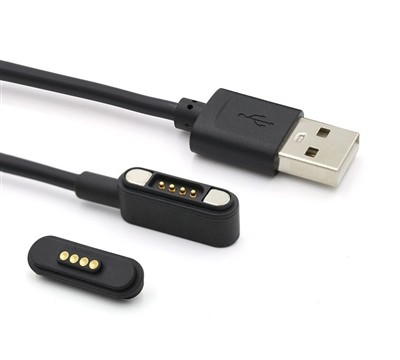
| Consumer Electronics | Smartphone battery connections, TWS earbud charging cases, smartwatch magnetic charging, MagSafe interfaces |
| Wearables | VR/AR headset charging cradles, smart fitness bands, sports monitoring devices |
| Automotive | BMS power battery voltage/temperature sensing, ECU module test interfaces, OBD‑II diagnostic ports |
| Industrial & Medical | ICT/FCT automated test probes, portable patient monitors, handheld POS payment terminals |
| Specialty | Aerospace satellite connections (radiation‑resistant plating), underwater robotics (IP68 waterproof) |
| Data Transmission | Supports high‑speed signals up to 10 Gbps (USB 3.1 Gen2 / Thunderbolt 3) |

VII. Selection Considerations
Current requirement: For high‑current applications, choose high‑current series pins or use multiple pins in parallel.
Contact force: Typical range 50 ~ 300 gf – balance insertion comfort with contact reliability.
Stroke design: Recommended to keep compression within 50% ~ 70% of total travel for optimal performance.
Plating: Standard gold plating improves corrosion resistance and conductivity; harsh or high‑reliability environments (military, medical) require thicker gold.
High‑frequency applications: Choose coaxial shielded designs to reduce crosstalk and insertion loss.
Environmental protection: For outdoor or humid environments, select waterproof models with sealing structures (IP67/IP68).

Summary
With their small size, stable contact, and long life, POGO PIN connectors have become an indispensable connection solution in modern electronics – from consumer devices to high‑reliability aerospace applications.