
Connector introduction and its application
Introduction and application of new energy vehicle wiring harness, automotive connector, flexible connector
The automotive wiring harness is a key component of the automotive electrical system. Its main function is to transmit and transmit energy signals, and it is an important carrier of automotive circuits.

The automotive wiring harness is mainly composed of wires, terminals, connectors, and sheaths, and the automotive connector is the core component of the automotive wiring harness.
The car connector sets up a bridge of communication between the circuits where the car circuit is blocked or isolated so that the current flows and the predetermined function is realized.

Automotive connectors are mainly composed of four basic structures: contacts, shells, insulators, and accessories.
Automotive connectors are used in various functional wiring harnesses throughout the car.
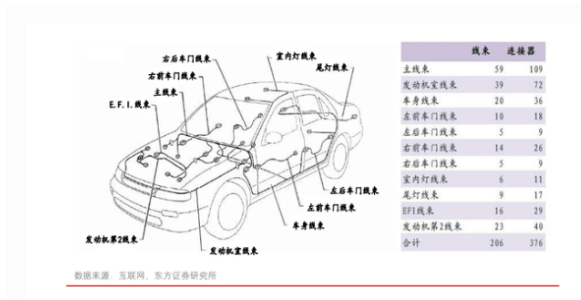
For the main categories of new energy vehicle connectors, see the figure below:

The soft connector is a key component of new energy vehicles. Soft connector, also known as flexible busbar, is based on the technology of laminated busbar. It is composed of multi-layer anti-corona flat thin copper conductors. It is made by covering the insulating layer. Because the flexible part of the soft connector has good shrinkage and shock resistance, it is widely used in the connection of power devices in the new energy vehicle bodies, battery, motor, electronic control, and other systems, and has high technical content and value.
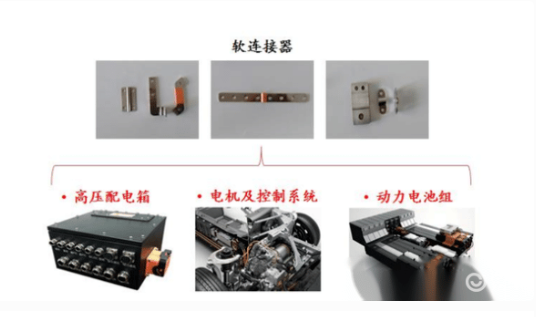
Compared with ordinary cables, soft connectors have the advantages of large current carrying capacity, strong flexibility, convenient installation, and cost-saving, and have a broad market space in the application field of new energy vehicles.
In the new era, various scientific and technological terms have appeared, such as flexible connections, wiring harnesses, and bus bars. We give him a new meaning again.