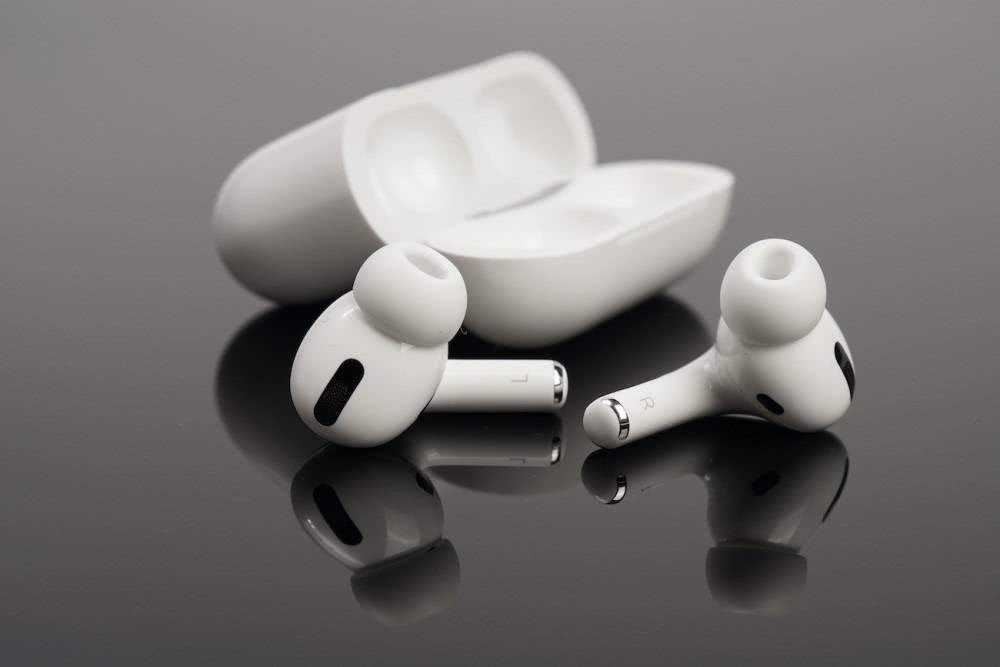
As early as 2014-2016, some audio companies launched the first generation of truly wireless earphones on the market, but they had some problems with Bluetooth connection, microphone, battery, etc. In 2016, Apple officially canceled the 3.5mm audio jack on the iPhone 7 series and launched a new product, Apple AirPods, which can be smoothly paired with iPhone, iPad, and MacBooks in seconds, and the seamless connection of Bluetooth is amazing. Incredible degree.

As soon as Airpods was launched, this solution with dual-channel transfer technology and charging case quickly led the market. For a while, True Wireless Stereo Headphones (TWS) became the most popular type of headphones on the market. Android and audio manufacturers followed suit, such as Sony, Beats, Bose, Jabra, Sennheiser, etc. all launched their products, and the TWS brands on the market are changing with each passing day. After more than five years of development, TWS wireless earphones have become the fastest-growing consumer electronics product.
How is TWS+ related to TWS?
When talking about TWS, we often hear the term TWS+, so what are the correlations and differences between the two?
TWS uses the Bluetooth 5.0 main and auxiliary ear transmission technology. When connecting, the headset needs to be connected to the main ear (usually the right ear) first, and then the main gear and the auxiliary ear are connected, so the time required for connection is compared. long. Therefore, TWS is more susceptible to external interference, and its power consumption is high.
TWS+
TWS+ (True Wireless Stereo Plus) is a proprietary technology of Qualcomm, which was introduced in the Snapdragon 845 processor introduced by Qualcomm in 2017 on Android phones. TWS+ is an evolution of TWS. Both of its earphones can be directly connected to the audio source. As the name suggests, the left and right ears can work independently. This allows each earphone to receive the corresponding audio signal with minimal loss, connecting quickly and saving power. While TWS+ compatible headphones offer higher sound quality, the feature also depends on the audio source being compatible.
In February 2018, Qualcomm launched the TWS+ technology to achieve normal work between TWS headsets using Qualcomm QCC5100/QCC30XX Bluetooth chips and mobile phones based on mobile platforms such as Snapdragon 845/7XX/855/865. By using this solution, there will be two independent communication links that are directly transmitted to the left and right channels to achieve independent connections. When playing music, even if one earphone is removed, the music will not be interrupted.

The current status quo is that all true wireless earphones are compatible with TWS, but not all of them support TWS+.
The booming TWS market
Although TWS technology is increasingly used in laptops, tablets, and TVs, smartphones are still the most popular pairing device for TWS, and major smartphone makers including Apple and Samsung have pulled the plug from their latest releases. Remove the 3.5mm audio jack.

At present, the TWS earphone market has developed from a dark horse to a golden horse, and the market and sales volume have grown steadily year by year. In its 2020 Global Consumer Audio Survey, Qualcomm mentioned that the global adoption of TWS headsets has nearly doubled since 2019, from 23% to 42%. That said, about 42% of consumers use wireless headphones to watch TV, movies, and other video content. That number is expected to continue to rise as battery life improves further.
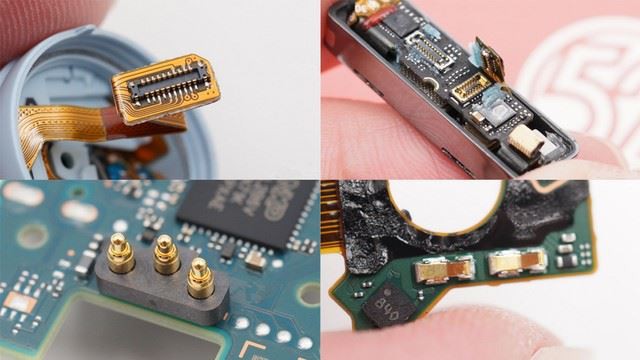
According to the forecast of grand view research, the global TWS headset market size will be approximately USD 25.32 billion in 2020 and is expected to grow at a CAGR of 36.1% from 2021 to 2028. With the ever-expanding demand for streaming content coupled with the rapid adoption of social media and short video applications, the growth of the TWS headset market is expected to continue to accelerate in the next few years.
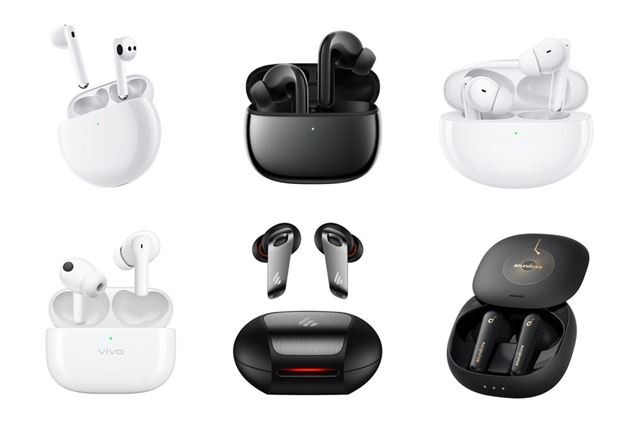
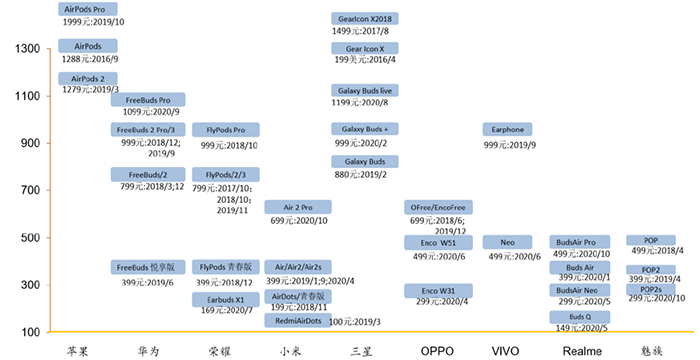
According to Strategy Analytics, in 2020, the total global sales of Bluetooth headsets have exceeded 300 million, and the sales of TWS headsets have exceeded half of this figure to 170 million. Specifically, the development trend of the global TWS headset market is similar to that of the smartphone market 10 years ago. Apple leads the industry and mainly occupies the high-end market, while Android gradually penetrates the low-end market through a low-price strategy, and its penetration rate trend There are also similarities with previous smartphones. Research data from Strategy Analytics shows that with the launch of the AirPods Pro, Apple AirPods sales have grown rapidly from 1 million in 2016 to 15 million in 2018, and a staggering 60 million in 2019.

Analysts at Juniper Research estimate that Apple sold nearly 85 million AirPods in 2020, accounting for about 70% of total TWS category revenue and a 55% market share of products sold.
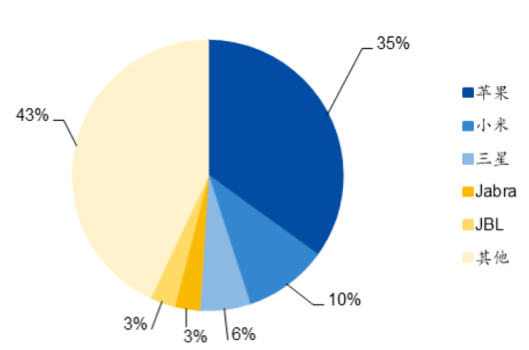
From the perspective of brand distribution, the TWS headset market was first detonated by Apple. After several years of development, its product AirPods has a very high market share in the mid-to-high-end market. According to the analysis data from Counterpoint, as of the second quarter of 2020, the top three companies in the TWS market are Apple (35%), Xiaomi (10%), and Samsung (6%). market.

01
One of the core technologies of TWS: Bluetooth 5.0
Bluetooth is a wireless transmission technology that theoretically enables short-range connections between devices within 100 meters. In practice, when using small devices, we usually use an effective distance of about 10 meters. The greatest feature of Bluetooth is that it enables mobile communication devices and computers to network and transmit data and messages without the use of cables. It can be said that Bluetooth technology is a major turning point in the development of headphones, and it is one of the most important technologies in TWS.
Compared with the previous generation of Bluetooth 4.2, Bluetooth 5.0, which came out in June 2016, has a longer transmission distance and faster transmission rate. The effective transmission distance is 4 times that of the BLE 4.2 version, and the transmission rate is 2 times higher. Bluetooth 5.0's significant optimizations in transfer rate and latency enable many applications for wireless devices that require more information and faster response. In terms of practical use, the high transmission bandwidth of Bluetooth 5.0 also makes TWS two-way talk possible, and the higher bit rate makes audio playback more natural.
Bluetooth 5.2 represents the latest development in Bluetooth technology. In 2020, the Bluetooth SIG launched LE audio, a new generation of Bluetooth audio technology standards. It is based on the Bluetooth 5.2 standard and adopts the new "LC3" audio decoder with good sound quality and low power consumption, which can compress audio data more efficiently and transmit more data on lower bandwidth without sacrificing audio quality, which is good for both audio quality and power efficiency. The most anticipated advancement in Bluetooth 5.2 is the introduction of Sync Channel, a technology that allows us to connect multiple Bluetooth devices to a single source. Just imagine how comfortable it would be if we could connect to all devices at once and automatically switch between them without having to manually change the connection between it and the phone, PC, or TV when using TWS at home.
The rapid development of TWS has driven the industrial upgrading of relevant supply chain manufacturers. Technological advancements in the main control chip, power management chip, wireless charging receiver chip, charging box battery, earbud battery, touch control, and other technologies have improved the performance and functions of TWS headphones and brought a better user experience.
02
The second core technology of TWS: Bluetooth main control chip
In TWS, the importance of the Bluetooth master chip is self-evident. Different from relatively bulky mobile phones and other earphones, the portability requirements of TWS have higher requirements on the size and integration of the main control chip. With the addition of new modules such as noise reduction and functional sensors, higher requirements are placed on the space utilization of the cavity and the high integration of the chip. A Bluetooth master SoC with comprehensive functions and high integration provides a strong guarantee for TWS to realize various functions.
At present, there are dozens of manufacturers in the TWS main control chip market, the market is gradually maturing, and the competition among manufacturers is fierce. The high-end market is represented by Apple, Qualcomm, Hengxuan, and Broadcom, and the mid-to-low-end market includes Luoda, Realtek, and Lanxun. According to incomplete statistics, as of October 2020, there were more than 22 TWS master Bluetooth chip manufacturers in China.
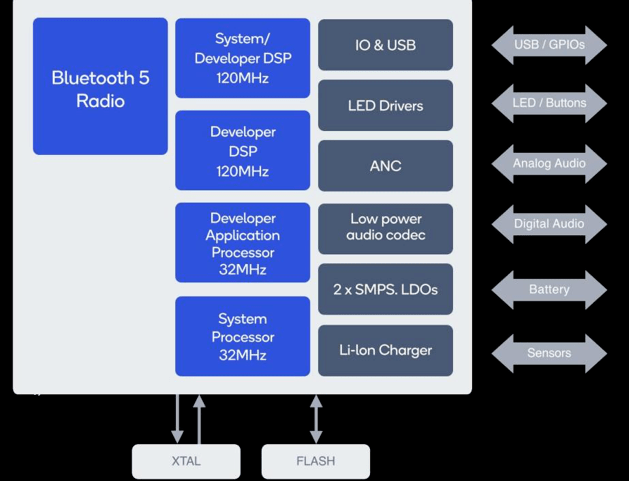
The Qualcomm QCC5124 system-on-chip (SoC) is designed to meet the needs of small devices for a robust, high-quality, wireless Bluetooth listening experience with low power consumption for longer audio playback. The QCC5124 architecture is designed for high performance with low power consumption. Compared to its previous technology, power consumption can be reduced by up to 65%, enabling longer audio playback in almost all operating modes.
03
TWS core technology three: active noise reduction
In recent years, the noise reduction function of TWS earphones has been paid more and more attention by consumers, and active noise reduction (ANC) technology has become the standard of high-end earphone products. Qualcomm's market research data shows that 71% of consumers are interested in active noise cancellation as a feature.
Since Apple released AirPods Pro, TWS headphones have begun to accelerate the transition to TWS + ANC. At present, the mainstream active noise reduction Bluetooth headsets on the market all adopt the solution of the separation of the Bluetooth chip and the active noise reduction chip. For TWS earphones with tight internal space, the single-chip solution not only consumes less power but also leaves more space for acoustic devices and battery modules. Therefore, this architecture will also become the development trend of TWS earphones. Of course, in addition to the active noise reduction chip, the noise reduction effect of TWS headphones is also related to the design of the headphone cavity, and the chip factory needs to work closely with OEM/ODM manufacturers.
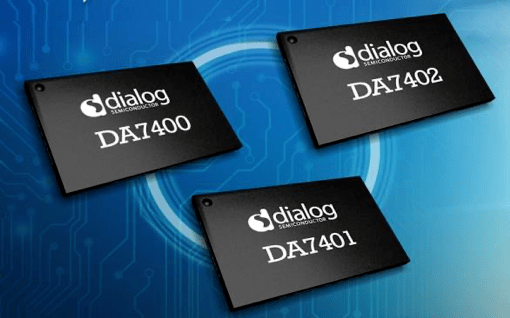
Dialog's DA7401 is a high-performance mono ANC codec designed for TWS headphones and smart ear-worn devices. It has a 115dB playback dynamic range, 103dB recording dynamic range, hybrid ANC, and flexible clock architecture.
The DA7402 is a high-performance, ultra-low-power stereo high-fidelity codec that uses Dialog's custom digital hybrid ANC technology to provide stronger ambient noise rejection in a wider frequency range, making it sound in any environment. for the best user experience. The DA7402 integrates an audio processor that provides excellent audio performance, including a dynamic playback range of 115dB and a sampling rate of 384kHz. In addition, it provides 40kHz audio bandwidth to support high-resolution audio.
The DA7402 is one of the smallest digital active noise cancellation codecs on the market today, consuming half the power of today's leading chip solutions and doubling the audio performance, making it ideal for sports headphones, smart ear-worn devices, TWS headphones, and more.
04
TWS core technology four: MEMS microphone
Many functions of TWS headsets require corresponding sensors to provide hardware support. At present, the main sensor units of TWS earphones include speakers for playing music, MEMS microphones for active noise reduction and communication, optical sensors for in-ear detection, bone voiceprint sensors for communication noise reduction, and 360 Six-axis sensors for surround sound, etc.
In the TWS headset, the previous microphone was mainly used for the voice call function. With the application of ANC noise reduction technology in TWS earphones, to achieve a better noise reduction effect, multi-microphone cooperation solutions have been widely used, and the performance requirements of microphones are also getting higher and higher. MEMS silicon chips have the advantages of small size and strong stability. Since the addition of a noise reduction function puts forward higher requirements on the performance of the microphone, MEMS microphones have become the first choice for TWS headset products.
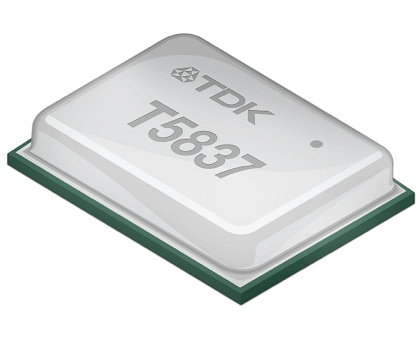
TDK's high-performance MEMS microphone T5837/38 PDM features a high Acoustic Overload Point (AOP) of 133dB SPL, a high signal-to-noise ratio of 68dBA, and a wide dynamic range, making it ideal for applications ranging from very quiet to very noisy, such as Field smart speakers to voice pickups for ANC TWS applications. The T5848 SmartSound I2S MEMS microphone can provide a high acoustic overload point of 133dB SPL, a high signal-to-noise ratio of 68dBA, and a wide dynamic range, suitable for applications that require high acoustic performance in dynamic and noisy environments.
05
TWS core technology five: power management chip
The power management chip is mainly used for charging and discharging TWS earphones, as well as real-time battery overcharge, over-discharge, overcurrent, and overtemperature monitoring and short circuit protection during the charging and discharging process. Although the charging and discharging power of the power management chip is relatively small compared with traditional devices, for TWS earphones with high portability requirements, it is necessary for safety, low power consumption, high withstand voltage, high integration, and high efficiency. The requirements are relatively high.
The MAX77650/MAX77651 are highly integrated, ultra-low-power power management chips (PMICs) ideal for low-power, size-constrained wearable applications such as TWS where size and efficiency are critical. Both chips contain a SIMO buck-boost regulator that provides three independently programmable power rails.
Additionally, the 150mA LDO provides ripple rejection for audio as well as noise-sensitive applications. The highly configurable linear charger supports various Li-ion battery capacities and includes battery temperature monitoring for increased safety (JEITA). The analog multiplexers in the MAX77650/MAX77651 can switch multiple internal voltages and current signals to external nodes for monitoring with an external ADC. A bidirectional I2C interface is available for configuring and checking the working status of the device.

Epilogue
TWS headphones are an integral part of the smart audio device industry and a nascent market. Yole Développement predicts that annual shipments of TWS headsets, hearing aids, smartwatches, and smart speakers will exceed 1.3 billion units by 2026, and high-quality audio will become a must for many applications such as games, AR/VR experiences, and 3D sound effects. backup function. Smartphones and earphones have a very high degree of ecological fit. At present, the global shipment of Android mobile phones is about 6 times that of Apple mobile phones. It is expected that in the future, the share of Android in the TWS earphone industry will increase significantly.
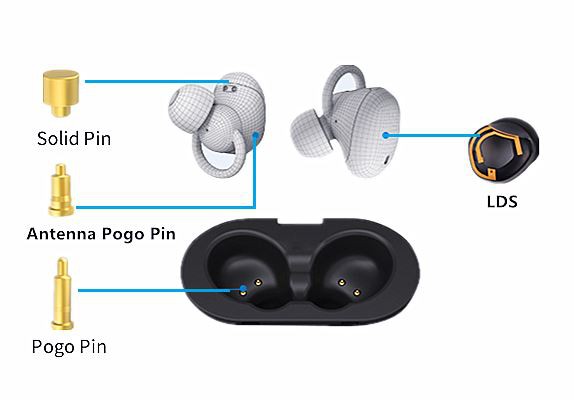
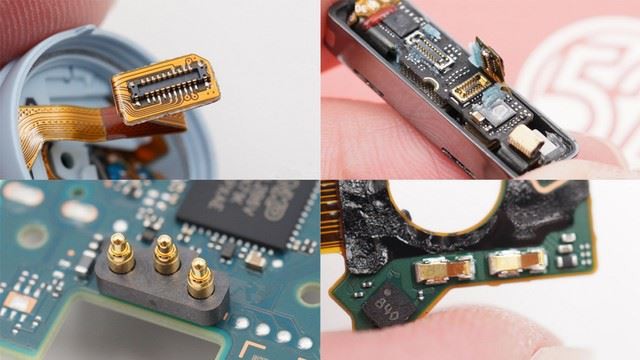
The most important thing is the pogo pin charging solution:
We are a pogo pin manufacturing and solution integrator.
Shenzhen ZZT Technology Co., Ltd. is a Chinese technology company that produces high-quality POGO PIN connectors that integrates design, R&D, manufacturing, electroplating, assembly, packaging, and sales.
We have been rated as a 5A enterprise in the industry. Passed IS09001 &IS014001 certifications, obtained more than 28 national invention patents, and won the "national high-tech enterprise" certification. We have accumulated a wealth of theoretical and practical experience and can provide customers with complete design and suitable development solutions.