
Pogo Pins and Pogo Pin Connectors as Charging Solutions in the AI Sector

AI hardware is rapidly evolving toward "portless, wearable, and autonomously mobile" form factors. From AI glasses to humanoid robots, from desktop companion devices to logistics AMRs, traditional plug-in interfaces are gradually revealing limitations in space, waterproofing, and automated charging. Pogo Pins (spring-loaded pins) and their magnetic connector solutions, with a combination of compact size, blind-mate tolerance, high durability, and low contact resistance, are becoming the mainstream choice for charging interfaces on AI devices. Their core value lies not in "replacing Type-C," but in solving the charging accessibility problem of AI devices in scenarios of extreme spatial constraints and unmanned operation.
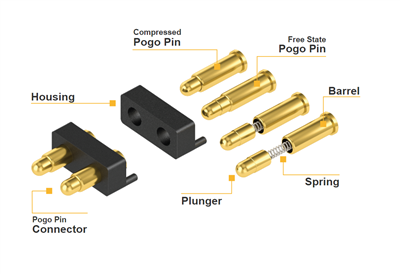
I. AI Glasses and Wearables: The Rigid Charging Demand Within Millimeter-Scale Spaces
AI glasses are one of the fastest-penetrating categories for Pogo Pin charging solutions. The interior space of the temple is extremely narrow and elongated, and overall weight and appearance requirements are stringent; traditional interfaces struggle to fit without compromising design integrity. Magnetic Pogo Pin contacts are typically hidden at the end of the temple or inside the charging case, so that proximity triggers automatic magnetic alignment, eliminating the daily burden of aligning and inserting into a small hole.
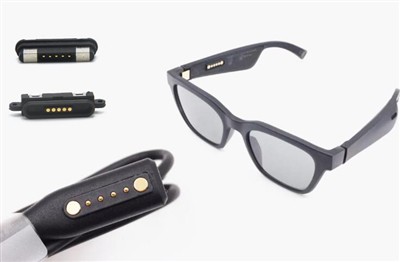
Technical challenges concentrate in three dimensions. Height constraints: the stacking space in smart bands and glasses temples often requires Pogo Pin total height to be kept extremely low. Mass-production solutions disclosed by C.C.P. Contact Probes show that their self-developed pin body structure can compress total height to 1.25mm while maintaining stable contact force. Contact resistance and heat: standard stainless steel materials have relatively high contact resistance, which is unfavorable for fast charging and thermal control. Proprietary alloy solutions can reduce contact resistance at 80g contact force to 95mΩ, roughly 16% lower than standard materials. Human contact safety: AI glasses are worn against the skin for extended periods, and sweat, cosmetics, and salt-spray environments pose a direct corrosion threat to contacts. High-end solutions require passing 168 hours or more of salt spray and sweat testing, with plating that meets nickel release regulations and electrolytic corrosion resistance requirements (electrolytic tolerance >60min, far exceeding standard gold plating's <1min).

On the charging case side, Pogo Pin arrays also play a key role. Spring pins inside the glasses case mate with temple contacts, and with Hall sensors enable "open-to-charge" behavior. Some patented designs further place magnetic Pogo Pin interfaces in the frame hinge area, using structural alignment in the folded state to ensure contact reliability. Manufacturers such as CFE (Chuanfu Electronics) have integrated temple magnetic charging, glasses case charging docks, and frame-embedded expansion connections into system-level solutions, supporting data synchronization and firmware upgrades during charging.

II. Robots and Autonomous Mobile Devices: The Three-Way Trade-Off Among Tolerance, Durability, and High Current
The AI robot category spans a wide range, from desktop companion robots to humanoid robots and AGVs/AMRs, with clearly stratified requirements for charging interfaces.

Desktop AI devices have relatively moderate charging needs but emphasize "frictionless" operation. The Tuya T5 AI pocket device, in addition to USB Type-C, is equipped with an extra Pogo Pin expansion interface (power + UART) for dock mating and functional expansion. Living.AI's AIBI pocket pet adopts a 4-pin Pogo Pin solution: 2 pins for power (V+ / GND), and the other 1–2 pins for dock detection, charging status handshake, or firmware interaction. This "power + signal" mixed pin definition makes the charging action simultaneously a trigger for device wake-up and status synchronization, enhancing the interaction continuity of desktop AI devices.
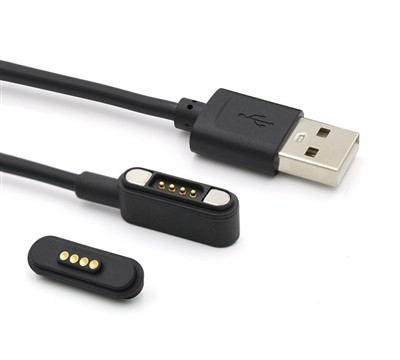
Humanoid robots and embodied intelligence devices impose requirements of a higher order on Pogo Pins. Positional deviation during charging dock mating is the norm, and the floating contact mechanism of spring pins naturally provides a degree of tolerance. C.C.P.'s Crown Spring series uses a multi-contact copper alloy spring structure that generates radial contact force during insertion and extraction to compensate for positional offset, with a rated lifespan of 10,000+ mating cycles across the series. In terms of current capacity, traditional Pogo Pins typically cap below 10A, while humanoid robot fast-charging demands can exceed 15A. Four-piece rear-crimp high-current structures reduce internal thermal resistance by expanding the conductive cross-section, keeping temperature rise of a 15A continuous path within 30°C.

AGV/AMR logistics robots place even greater emphasis on "absolute reliability under unattended operation." Yokowo's analysis notes that AGVs/AMRs require multiple autonomous charging sessions per day, and the core requirements for charging contacts are, in order: positional deviation tolerance, repeated mating durability, and contact stability under contamination and vibration. Compared with wireless charging, Pogo Pin solutions have clear advantages in power efficiency and implementation cost; compared with plug-in interfaces, they win on automation compatibility and maintainability. The combination of high-current models (such as 15A-class spring connectors) and waterproof design enables Pogo Pin charging stations to operate maintenance-free on industrial sites over the long term.

III. Key Dimensions of Technical Selection and Trends
Synthesizing the application landscape across AI categories, the design trade-offs for Pogo Pin charging solutions concentrate on the following dimensions:
| Dimension | Wearables / AI Glasses | Desktop AI Devices | Robots / AMRs |
|---|---|---|---|
| Primary constraint | Height and weight | Mating convenience | Tolerance and durability |
| Typical pin count | 2 pin (charging only) | 2–4 pin (charging + signal) | 2–4 pin (including high current) |
| Key metrics | 1.25mm-class total height, sweat resistance | Magnetic self-alignment | 10,000+ cycle life, 15A-class current carrying |
| Plating requirements | Electrolytic corrosion resistance >60min | Standard gold plating | Salt spray / contamination resistance |

From a supply chain perspective, Pogo Pin applications in the AI sector are evolving from "single charging contacts" toward "charging + data + structural integration." Manufacturers including CFE, C.C.P., and Yokowo have all launched complete connection modules for AI glasses, embodied robots, and smart wearables, covering integrated delivery of spring pins, magnetic heads, cable harnesses, and charging docks. Meanwhile, precision interconnect for AI data center compute modules has also begun to introduce micro Pogo Pin solutions; although the current volume is small, it hints at potential extension of Pogo Pins into the AI infrastructure layer.

Conclusion: The role of Pogo Pins in AI charging solutions is essentially an engineering reconstruction of the "physical contact" link of the interface. They use the elastic deformation of springs to absorb the precision shortfall of manual insertion and the positional error of robotic mating, use compact structures to free up stacking space in wearable devices, and use materials and plating technology to resist the corrosive attack of body-worn and industrial environments. As AI devices increasingly need to complete energy replenishment without human intervention, the "contact certainty" provided by Pogo Pins is precisely the key reason they are moving from consumer electronics accessories toward AI hardware infrastructure.
