
The Unsung Hero of Smart Devices: How Pogo Pins Are Quietly Shaping Our Connected World
In the design of tech products, some innovations are immediately visible-sharper displays, faster processors, sleeker silhouettes. Others, however, hide in plain sight, working behind the scenes to reshape our daily experiences in ways we rarely notice. The Pogo Pin-a small spring-loaded connector-is one such unsung hero. Inside your smartwatch, wireless earbuds, or VR headset, there are likely several tiny Pogo Pins silently doing their job.

The Hidden Enabler on Your Wrist: Banishing Charging Anxiety in Wearables
If you own a smartwatch, you know the ritual: at the end of the day, you casually place it onto its charging dock, and with a satisfying magnetic click, it aligns perfectly and begins charging. No fumbling with ports, no repeated plugging and unplugging. Behind this seamless experience lies a perfect partnership between Pogo Pins and magnetic alignment structures.
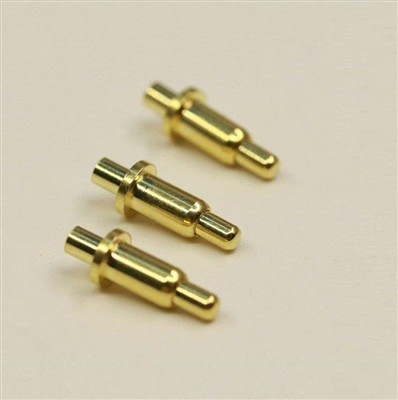
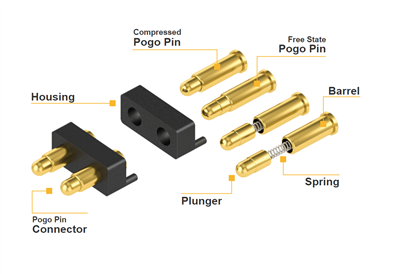
The internal space of smart bands and watches is extremely limited-batteries, chips, and sensors already occupy nearly every square millimeter, leaving little room for traditional charging interfaces. Pogo Pins, however, can be manufactured to incredibly small sizes-as thin as 0.3mm-while still handling fast-charging currents of up to 5 to 10 amperes. Consisting of three parts-plunger, spring, and tube-each Pogo Pin delivers stable contact force through its internal spring, enabling reliable charging and signal transmission in confined spaces.
What's more, the elastic structure of Pogo Pins effectively compensates for assembly tolerances and the tiny gaps that develop over extended use. Even after tens of thousands of charge-discharge cycles, they maintain low contact resistance and stable conductivity. This is precisely why virtually every major smartwatch brand has chosen Pogo Pins as their charging solution-they make "just drop and charge" a reality, while users remain blissfully unaware of their existence.

In 2023, global shipments of smart wearable devices exceeded 500 million units, with projections reaching 640 million by 2028. Behind each of these devices, there are typically 3 to 6 Pogo Pins quietly supporting the user experience day in and day out.

The Test Floor Workhorse: Boosting Production Yields by 15%
Beyond consumer electronics, Pogo Pins play an equally critical role in manufacturing production lines.
Step into the testing section of an electronics factory, and you'll see rows upon rows of Pogo Pins precisely arranged in automated test fixtures, forming a "bed of nails" that simultaneously contacts test points on circuit boards to rapidly complete continuity checks and signal verification.
The key advantage of Pogo Pins in this application is that each pin can independently retract and extend by a tiny amount, automatically compensating for height variations in solder joints to ensure stable contact with every test. Compared to traditional testing methods, Pogo Pin-based test fixtures can reduce single-board test time from 45 seconds to just 12 seconds, while improving yield rates by 15%. They are the unsung heroes of quality control on the production line-helping inspectors quickly identify defects in high-volume manufacturing and ensuring that every shipped product meets quality standards.

From Medical Devices to Smart Cars: The Expanding Application Landscape
In medical settings, the reliability of Pogo Pins carries even greater responsibility. From hearing aid charging cradles to ECG monitoring devices, from pulse oximeters to operating-room physiological monitoring modules, Pogo Pins must not only transmit signals stably but also withstand long-term exposure to disinfectants and bodily fluids. In these applications, connector failure could affect diagnostic accuracy or even compromise patient safety-which is why medical-grade Pogo Pins must comply with stringent biocompatibility and disinfectant-resistance certification standards.
In the automotive electronics sector, the proliferation of smart cockpits and ADAS (Advanced Driver-Assistance Systems) has dramatically increased the number of connectors per vehicle. Pogo Pins, with their compact size, vibration resistance, and high-current capability, are widely used in in-vehicle charging cradles, sensor modules, smart rearview mirrors, and more. According to projections from the International Energy Agency, global electric vehicle sales will exceed 38 million units by 2030, driving enormous demand for high-reliability connectors.

Why Choose Pogo Pins?
To summarize, the widespread adoption of Pogo Pins across so many industries stems from several core strengths:
Compact size, space-saving: With heights as low as a few millimeters, they are ideal for space-constrained product designs
Reliable connection, long lifespan: The elastic structure compensates for tolerances, with mating cycles reaching tens of thousands or even over 100,000 times
Easy installation: Magnetic alignment delivers a smooth user experience, while high assembly efficiency benefits production lines
Supports high current and waterproofing: Meets the demands of fast charging and outdoor applications
Broad application scope: From consumer electronics to medical, automotive, and industrial sectors, covering virtually every field that requires precision interconnection

Conclusion
Pogo Pins rarely appear in prominent positions on product spec sheets or marketing materials. But they are there-on your watch charger, inside your earbud case, on the factory test bench, within medical monitoring equipment-quietly, steadily, connecting our increasingly intelligent world.
If you are looking for high-reliability, customized connection solutions, feel free to reach out to us for samples or a tailored proposal.
